
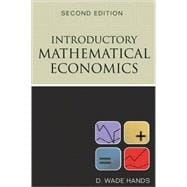
Introductory Mathematical Economics
by Hands, D. WadeEdition: 2nd
Format: Hardcover
Pub. Date: 2003-07-24
Publisher(s): Oxford University Press
 Other versions by this Author
List Price: $285.30
Buy New
Usually Ships in 5-7 Business Days
$271.71
Rent Textbook
Select for Price
Used Textbook
We're Sorry
Sold Out
eTextbook
We're Sorry
Not Available
How Marketplace Works:
- This item is offered by an independent seller and not shipped from our warehouse
- Item details like edition and cover design may differ from our description; see seller's comments before ordering.
- Sellers much confirm and ship within two business days; otherwise, the order will be cancelled and refunded.
- Marketplace purchases cannot be returned to eCampus.com. Contact the seller directly for inquiries; if no response within two days, contact customer service.
- Additional shipping costs apply to Marketplace purchases. Review shipping costs at checkout.
Summary
A strong relationship clearly exists between mathematics and modern economics; mathematics helps extend and formalize economic theory, and quantitative economic data influences the development and refinement of mathematical models. In Introductory Mathematical Economics, 2/e, author D. WadeHands introduces students to a variety of new mathematical tools and explains how to apply those tools to a broad range of economic problems. The book begins with an overview of the necessary mathematical background, then presents a number of more advanced mathematical tools that allow students toexpand their knowledge of economics. It offers a mix of classical and contemporary economic theory, covering the standard mathematical techniques such as optimization and comparative statics, as well as more specialized topics such as uncertainty, dynamics, nonlinear programming, and matrix theory. Thoroughly revised and updated, this second edition offers students a wide range of mathematical techniques and the associated economic theory. The new Chapter 0, a mathematical review covering all prerequisite mathematics, serves as both a precourse mathematics refresher and a handy reference.All end-of-chapter problems are economics problems; many are detailed and require a substantial amount of economic interpretation in addition to the technical analysis. These problems have been revised and expanded in this second edition. Boxes in each chapter provide economic examples of relevantmathematical concepts. Several boxes discuss recent developments in economic theory, while others present results that influenced the evolution of modern economics. Featuring a clear and concise presentation of mathematical and economic concepts, Introductory Mathematical Economics, 2/e, is idealfor undergraduate courses in mathematical economics.
Table of Contents
| Starting with Chapter 1, each chapter ends with Problems and Notes | |
| Mathematical Notation | |
| Mathematical Symbols | |
| The Greek Alphabet | |
| Review of Mathematics | |
| Some Basic Mathematical Concepts | |
| Calculus | |
| Matrices and Related Topics | |
| Economic Applications of One-Variable Calculus | |
| Applications of One-Variable Calculus from Introductory Economics | |
| Optimization Examples from Introductory Economics | |
| An Introduction to Concavity and Convexity | |
| Economic Applications of Multivariate Calculus | |
| Partial Derivatives and the Total Difference in Economics | |
| Homogeneous Functions | |
| Homothetic Functions | |
| Concave Functions in n Variables | |
| Comparative Statics I: One and Two Variables with and without Optimization | |
| Equilibrium Comparative Statics in One and Two Dimensions | |
| Comparative Statics with Optimization in One and Two Dimensions | |
| Comparative Statics with Both Equilibrium and Optimization | |
| Integration, Time, and Uncertainty in Economics | |
| Integration | |
| Time | |
| Uncertainty | |
| Introduction to Continuous Time Dynamics in One and Two Dimensions | |
| Single-Market Competitive Equilibrium | |
| Examples of One-Variable Dynamic Economic Models | |
| Multiple-Market Competitive Equilibrium | |
| A Macroeconomic Example | |
| An Alternative Notion of Stability | |
| Matrices and Economic Theory | |
| Submatrices and Minors | |
| Cramer's Rule in Economics | |
| Inverse- and Implicit-Function Theorems | |
| A Special Class of Matrices: M Matrices | |
| The Leontief Input-Output System | |
| Quadratic Forms and Definiteness | |
| Comparative Statics II: n Variables with and without Optimization | |
| Equilibrium Comparative Statics in n Dimensions | |
| Comparative Statics with Optimization in n Dimensions | |
| Comparative Statics III: Optimization under Constraint | |
| The Lagrange Technique: First- and Second-Order Conditions | |
| A Specific Utility Function | |
| Choice between Labor and Leisure | |
| Comparative Statics from Constrained Optimization: Two Approaches | |
| Consumer Choice: The n -Good Case | |
| Additively Separable Utility Functions | |
| Inequality Constraints in Optimization Theory | |
| A Simple Inequality Constraint | |
| The General Kuhn-Tucker Theorem | |
| Economic Examples of Kuhn-Tucker Theory | |
| Linear Programming | |
| References | |
| Appendix: Answers to Selected Problems | |
| Index | |
| Table of Contents provided by Publisher. All Rights Reserved. |
An electronic version of this book is available through VitalSource.
This book is viewable on PC, Mac, iPhone, iPad, iPod Touch, and most smartphones.
By purchasing, you will be able to view this book online, as well as download it, for the chosen number of days.
Digital License
You are licensing a digital product for a set duration. Durations are set forth in the product description, with "Lifetime" typically meaning five (5) years of online access and permanent download to a supported device. All licenses are non-transferable.
More details can be found here.
A downloadable version of this book is available through the eCampus Reader or compatible Adobe readers.
Applications are available on iOS, Android, PC, Mac, and Windows Mobile platforms.
Please view the compatibility matrix prior to purchase.