
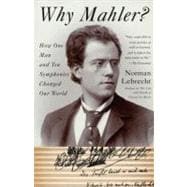
Why Mahler? How One Man and Ten Symphonies Changed Our World
by Lebrecht, NormanEdition: Reprint
Format: Paperback
Pub. Date: 2011-11-01
Publisher(s): Anchor
List Price: $21.40
Buy New
Special Order. We will make every effort to obtain this item but cannot guarantee stock or timing.
$20.38
Rent Book
Select for Price
Digital
$10.99*
Used Book
We're Sorry
Sold Out
How Marketplace Works:
- This item is offered by an independent seller and not shipped from our warehouse
- Item details like edition and cover design may differ from our description; see seller's comments before ordering.
- Sellers much confirm and ship within two business days; otherwise, the order will be cancelled and refunded.
- Marketplace purchases cannot be returned to eCampus.com. Contact the seller directly for inquiries; if no response within two days, contact customer service.
- Additional shipping costs apply to Marketplace purchases. Review shipping costs at checkout.
Summary
Although Gustav Mahler was a famous conductor in Vienna and New York, the music that he wrote was condemned during his lifetime and for many years after his death in 1911. #x1C;Pages of dreary emptiness,#x1D; sniffed a leading American conductor. Yet today, almost one hundred years later, Mahler has displaced Beethoven as a box-office draw and exerts a unique influence on both popular music and film scores. Mahler#x19;s coming-of-age began with such 1960s phenomena as Leonard Bernstein#x19;s boxed set of his symphonies and Luchino Visconti#x19;s film Death in Venice,which used Mahler#x19;s music in its sound track. But that was just the first in a series of waves that established Mahler not just as a great composer but also as an oracle with a personal message for every listener. There are now almost two thousand recordings of his music, which has become an irresistible launchpad for young maestros such as Gustavo Dudamel. Why Mahler? Why does his music affect us in the way it does? Norman Lebrecht, one of the world#x19;s most widely read cultural commentators, has been wrestling obsessively with Mahler for half his life. Pacing out his every footstep from birthplace to grave, scrutinizing his manuscripts, talking to those who knew him, Lebrecht constructs a compelling new portrait of Mahler as a man who lived determinedly outside his own times. Mahler was-along with Picasso, Einstein, Freud, Kafka, and Joyce-a maker of our modern world. #x1C;Mahler dealt with issues I could recognize,#x1D; writes Lebrecht, #x1C;with racism, workplace chaos, social conflict, relationship breakdown, alienation, depression, and the limitations of medical knowledge.#x1D; Why Mahler?is a book that shows how music can change our lives. From the Hardcover edition.
Author Biography
Norman Lebrecht has written several best-selling works of nonfiction, including The Maestro Myth and Who Killed Classical Music? He is also the award-winning author of the novels The Song of Names and The Game of Opposites. He writes regularly for Bloomberg.com and The Wall Street Journal, and he presents The Lebrecht Interview series on BBC Radio 3 and The Record Doctor on WNYC. He lives in London.
Table of Contents
| Preface: After Mahler, Another Deluge? | p. vii |
| Introduction: Desperately Seeking Mahler | p. xi |
| Why Mahler? | |
| Some Frequently Asked Questions | p. 3 |
| Who is Mahler?: The Life and Times | |
| Living in a Nowhere Land (1860-1875) | p. 21 |
| City of Dreams (1875-1887) | p. 34 |
| A Symphony Like the World (1887-1891) | p. 46 |
| Rise Again (1891-1894) | p. 58 |
| What Love Tells Me (1895-1897) | p. 72 |
| A Taste of Power (1897-1900) | p. 86 |
| The Most Beautiful Girl in Vienna (1901) | p. 103 |
| Small Interludes of Happiness (1902-1906) | p. 121 |
| Three Hammerblows (1907) | p. 140 |
| Discovering America (1907-1910) | p. 152 |
| "To Live for You, To Die for You" (1910-1911) | p. 177 |
| After Mahler (1911-2010) | p. 198 |
| Whose Mahler? | |
| A Question of Interpretation | p. 211 |
| How to Mahler | |
| Finding the Key to a Private Space | p. 261 |
| Acknowledgments | p. 264 |
| Notes | p. 267 |
| Bibliography | p. 290 |
| Index | p. 301 |
| Table of Contents provided by Ingram. All Rights Reserved. |
Excerpts
The Vienna of Freud, Mahler, Mach, Wittgenstein, Schnitzler, Herzl, Trotsky, and the young Hitler forged the world we know today. It was a meeting point of individualism and collectivism, egotism and idealism, the erotic and the ascetic, the elevated and the debased. At its center whirled Gustav Mahler . . . The man and his music are central to our understanding of the course of civilization and the nature of human relationships.
Art that is both high and low, original and derived, breathtaking and banal, Mahler’s music resists textbook analysis. It is an open-ended mind game of intellectual and ironic discourse, a voyage of discovery that combines self-revelation, consolation, and renewal . . . Each symphony is a search engine for inner truths. To know Mahler is ultimately to know ourselves.
From the Hardcover edition.
An electronic version of this book is available through VitalSource.
This book is viewable on PC, Mac, iPhone, iPad, iPod Touch, and most smartphones.
By purchasing, you will be able to view this book online, as well as download it, for the chosen number of days.
Digital License
You are licensing a digital product for a set duration. Durations are set forth in the product description, with "Lifetime" typically meaning five (5) years of online access and permanent download to a supported device. All licenses are non-transferable.
More details can be found here.
A downloadable version of this book is available through the eCampus Reader or compatible Adobe readers.
Applications are available on iOS, Android, PC, Mac, and Windows Mobile platforms.
Please view the compatibility matrix prior to purchase.